Documente Tehnice (Imaginile sunt cu titlu informativ. Va rugam sa consultati specificatiile tehnice.)
Specificatii
Marca
onsemiProduct Type
Monostable Multivibrator
Logic Family
TTL
Number of Elements per Chip
2
Minimum Pulse Width
120ns
Maximum Quiescent Current
150μA
Tensiune de alimentare minima
3V
Montare
Surface
Tip pachet
SOIC
Tensiune de alimentare maxima
18V
Numar pini
16
Maximum Propagation Delay Time @ CL
15μs
Temperatura minima de lucru
-55°C
Multivibrator Type
Frequency Divider
Temperatura maxima de lucru
125°C
Lungime
10mm
Inaltime
1.5mm
Standards/Approvals
No
Series
MC14521
Automotive Standard
AEC-Q100
Detalii Produs
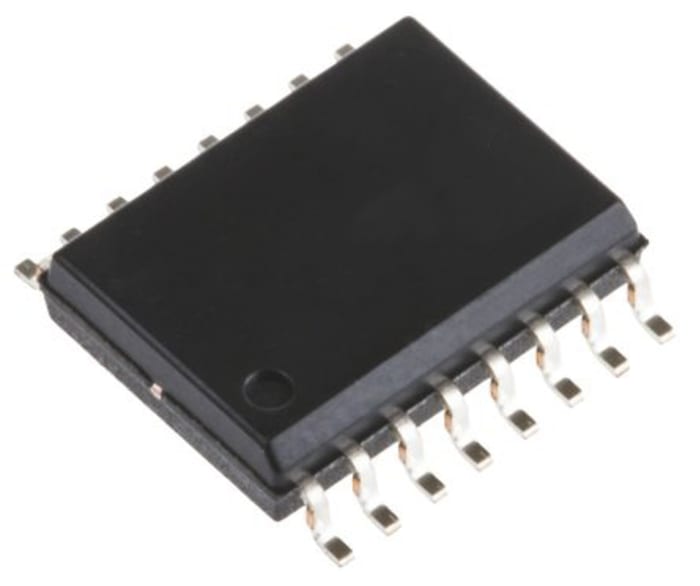
The MC14521B consists of a chain of 24 flip-flops with an input circuit that allows three modes of operation. The input will function as a crystal oscillator, an RC oscillator, or as an input buffer for an external oscillator. Each flip-flop divides the frequency of the previous flip-flop by two, consequently this part will count up to 224 = 16,777,216. The count advances on the negative going edge of the clock. The outputs of the last seven-stages are available for added flexibility.

Inspiră. Proiectează. Colaborează
ÎNSCRIE-TE GRATIS
Fara taxe ascunse!


Informatii despre stoc temporar indisponibile
P.O.A.
Buc. (Intr-un pachet de 25) (fara TVA)
Standard
25
P.O.A.
Buc. (Intr-un pachet de 25) (fara TVA)
Informatii despre stoc temporar indisponibile
Standard
25
Inspiră. Proiectează. Colaborează
ÎNSCRIE-TE GRATIS
Fara taxe ascunse!
Documente Tehnice (Imaginile sunt cu titlu informativ. Va rugam sa consultati specificatiile tehnice.)
Specificatii
Marca
onsemiProduct Type
Monostable Multivibrator
Logic Family
TTL
Number of Elements per Chip
2
Minimum Pulse Width
120ns
Maximum Quiescent Current
150μA
Tensiune de alimentare minima
3V
Montare
Surface
Tip pachet
SOIC
Tensiune de alimentare maxima
18V
Numar pini
16
Maximum Propagation Delay Time @ CL
15μs
Temperatura minima de lucru
-55°C
Multivibrator Type
Frequency Divider
Temperatura maxima de lucru
125°C
Lungime
10mm
Inaltime
1.5mm
Standards/Approvals
No
Series
MC14521
Automotive Standard
AEC-Q100
Detalii Produs
The MC14521B consists of a chain of 24 flip-flops with an input circuit that allows three modes of operation. The input will function as a crystal oscillator, an RC oscillator, or as an input buffer for an external oscillator. Each flip-flop divides the frequency of the previous flip-flop by two, consequently this part will count up to 224 = 16,777,216. The count advances on the negative going edge of the clock. The outputs of the last seven-stages are available for added flexibility.
Inspiră. Proiectează. Colaborează
ÎNSCRIE-TE GRATIS
Fara taxe ascunse!